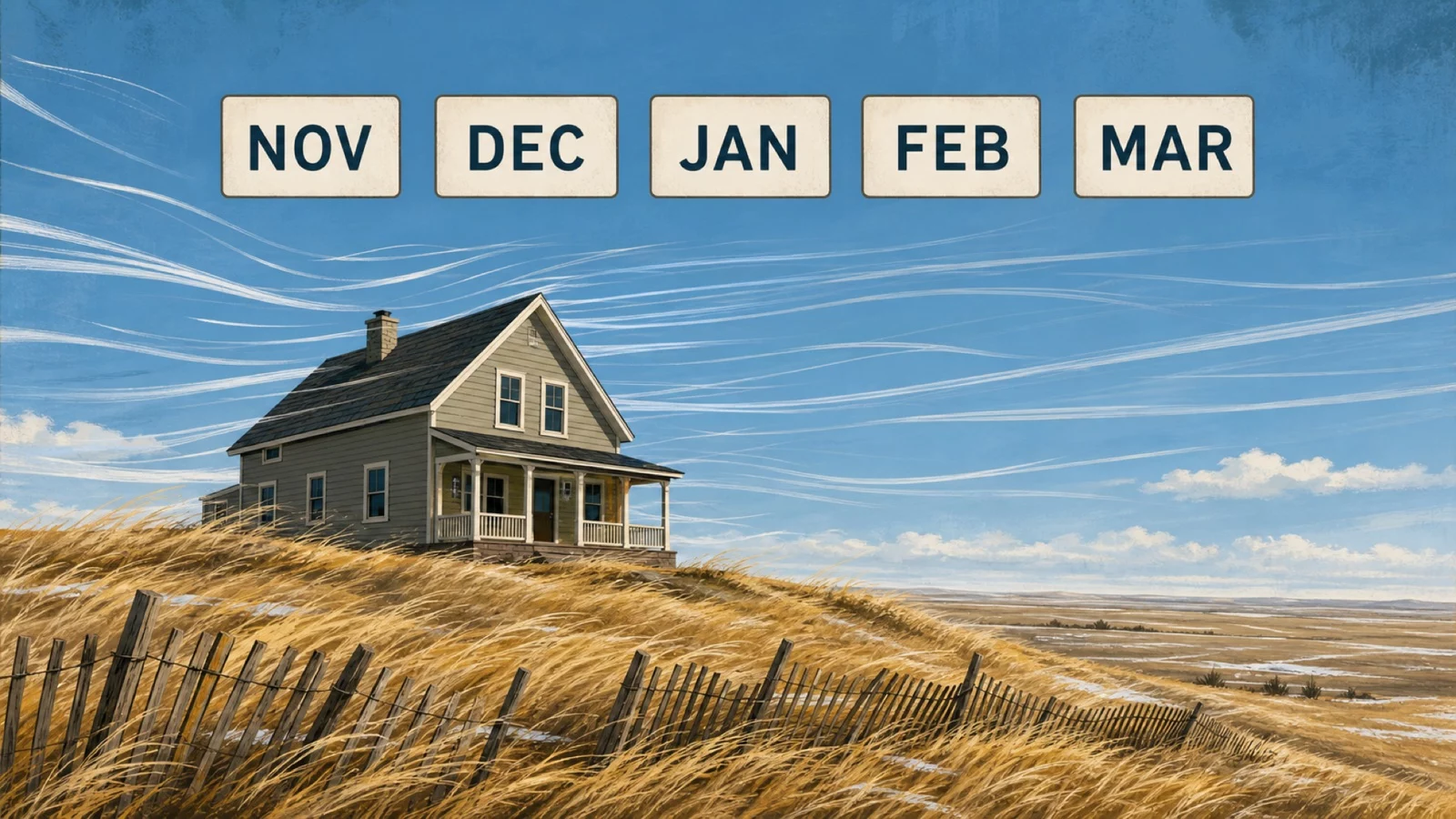
Southeast Wyoming’s wind season runs roughly November through March. Last winter, the National Weather Service warned of gusts up to 80 to 100 mph in wind-prone areas around Cheyenne in December, and a March windstorm gusted to 92 mph in Cheyenne and 81 mph at Laramie Regional Airport. Backed-out fasteners and loose ridge caps leave a roof more vulnerable to wind damage. September and October are the repair window. The checklist below covers fall repairs and what to do if wind damages your roof before they are completed.
Why is southeast Wyoming wind different?
Strong winds recur throughout the winter rather than arriving in a single storm. Along the I-80 and I-25 corridors, winter winds are downslope winds: air pouring off the Rockies and accelerating down the lee side of the Laramie Range onto the high plains where Cheyenne and Laramie sit. The Wyoming State Climate Office describes winter here plainly: “frequent periods when the wind reaches 30 to 40 mph with gusts of 50 or 60 mph,” with January typically the windiest month and Cheyenne’s strongest winds arriving from the west and northwest. Long-term NOAA data have ranked Cheyenne among the five windiest cities in the country, with an average annual wind speed near 13 mph, which includes the calmer summer months.
Two features of that profile matter for roofs:
- Repeated exposure. Strong winds can loosen roofing over several months. Hours of 30-40 mph sustained wind flex shingle bonds and wiggle fasteners, so that when the 70-90 mph gust arrives, it finds seams already loosened. The NWS issues a High Wind Warning at sustained winds of 40 mph for an hour or gusts of 58 mph: thresholds southeast Wyoming crosses routinely every winter, which is why NWS Cheyenne maintains a dedicated high-wind forecast page with five-day gust outlooks.
- Terrain concentrates wind. The same NWS page identifies wind-prone stretches (I-80 near Arlington and Buford, I-25 near Bordeaux and Wyo Hill), and homes along those corridors see the extreme end of every event. Homes near those corridors need roofing suited to local wind requirements.
What do roof wind ratings actually mean?
A shingle’s wind rating is a lab test classification, and the two that matter are easy to decode. ASTM D3161 is a fan-induced test: shingles that stay intact at 110 mph earn Class F, the top class. ASTM D7158 is the newer standard for sealed asphalt shingles, measuring resistance to wind uplift (the suction that actually peels roofs), and its top rating, Class H, corresponds to 150 mph. Our Wyoming high-wind materials guide goes deeper on choosing between architectural shingles, Class H products, and standing-seam metal for this climate.
Wind ratings depend on correct installation. A Class H shingle nailed with four nails in the wrong line, over a cold-weather install where the sealant strips never activated, does not perform at Class H. That’s why our Southeast Wyoming crews install Class H (150 mph) shingles with six-nail fastening patterns and sealed starter courses at the eaves and rakes: the edges and corners are where uplift concentrates, and where Wyoming roofs fail first.
The pre-season roof inspection checklist
Run this (or have us run it) in September or October, while repairs are schedulable and sealants still have warm afternoons to cure:
- Fastener back-out. Seasons of wind flexing work nails and screws upward. On shingle roofs, look for raised tabs and popped nail heads telegraphing through; on metal panels and trim, check exposed fasteners for backed-out screws and failed washers, and snug them before they become leverage points.
- Ridge and hip caps. Caps take wind from both sides and are usually the first shingles to go. Press-test them: any cap that lifts by hand, rocks, or shows cracked sealant needs re-fastening or replacement before November.
- Edge metal and flashing. Drip edge, rake trim, and sidewall/chimney flashing that has lifted even slightly lets wind get beneath it. Uplift starts at the edges; secure edge metal helps resist wind uplift.
- Previous repair points. Anywhere the roof has been patched (last winter’s tab replacements, a satellite-mount removal, an old swamp-cooler curb) is a discontinuity in the wind seal. Re-inspect every one; repairs age faster than the field of the roof.
- Sealant bond check (shingle roofs). Aged or dust-contaminated self-seal strips let tabs flutter. Fluttering tabs at 40 mph become missing tabs at 70. A roofer can spot unbonded tabs from the lift pattern and hand-seal problem areas.
- Gutters, soffit, and fascia. Loose gutter spikes and sagging fascia can pull away from the house in strong gusts, and torn-off gutters usually take drip edge and shingle edges with them.
- Check the attic. After a strong fall windstorm, check the attic for pinholes of daylight, shifted insulation, or new stains: signs of damage that may not be visible from the ground.
Why Schedule Repairs Before Wind Season?
A creased shingle found in October is a scheduled repair; the same shingle in a January windstorm is a hole in your roof with a tarp on it. Three reasons to schedule the work in fall:
- Crews are easier to schedule before a major storm. After a region-wide event like the March 2026 windstorm (downed power lines, blown-over semis on I-80 and I-25, damage across Cheyenne and Laramie) every roofer’s phone rings at once, and triage order, not your preference, sets the schedule.
- Cold weather makes repairs more difficult. Shingle sealant strips need warmth to bond; sub-freezing emergency repairs often have to be revisited in spring. Warm fall weather gives sealants a better chance to bond.
- Wind damage compounds. One missing tab exposes the nail line of the course above it; the next gust works that edge. Damage limited to a few shingles in fall can spread across a slope by winter and increase the repair cost.
What should you do when shingles come off mid-storm?
Stay off the roof while winds are strong. Wait until conditions are safe for a professional to install temporary protection. Steps to protect your home and document damage:
- Deal with safety hazards first. Downed lines near the house are a reason to contact the utility and keep away from the area.
- Document from the ground. Photograph the damaged slope, the debris in the yard (shingles, ridge caps and trim that show what failed), and note the date and time; NWS Cheyenne’s records will corroborate the gusts for any claim.
- Contain water from inside. If a leak opens, a bucket and a nudge of the insulation away from the drip protects the ceiling below until a repair can be made.
- Get a professional tarp-over once the wind drops. Temporary protection is part of the wind-damage response our Southeast Wyoming division does all winter: properly fastened tarps and temporary dry-in, done from the roof by people equipped for it.
- Then compare the documented repair cost with your deductible. Our Wyoming claims decision guide explains the comparison. Talk to your insurer or agent about your specific policy; this article is general information, not insurance advice.
An inspection before wind season can identify repairs while they are easier to schedule. Book a pre-season inspection before winter: we can identify loose shingles, fasteners and flashing before they cause further damage. Request a free estimate.
Wyoming Wind Season: Your Questions
When is wind season in Wyoming?
Roughly November through March in southeast Wyoming, when downslope winds off the Laramie Range hit the Cheyenne and Laramie area. The Wyoming State Climate Office describes frequent winter periods of 30 to 40 mph winds with gusts of 50 to 60 mph, and January is typically the windiest month. Individual storms can go much higher – a March 2026 windstorm gusted to 92 mph in Cheyenne.
How windy does it get in Cheyenne and Laramie in winter?
Sustained winds of 30 to 40 mph with gusts of 50 to 60 mph are routine, and the National Weather Service issues High Wind Warnings – sustained 40 mph or gusts 58 mph and up – many times each winter. Strong events bring far more: recent seasons have seen warnings for 80 to 100 mph gusts in wind-prone areas and a measured 81 mph gust at Laramie Regional Airport.
What is a Class H wind rating on shingles?
Class H is the top rating under ASTM D7158, the test standard that measures a sealed asphalt shingle’s resistance to wind uplift, and it corresponds to 150 mph. The other common standard, ASTM D3161, uses a fan-driven test where the top rating is Class F at 110 mph. The rating only holds if the installation matches it – fastening pattern, sealed starter courses, and proper nail placement matter as much as the shingle.
How do I prepare my roof for Wyoming wind season?
Have the roof inspected in September or October, before the wind arrives. The key checks are backed-out fasteners, loose ridge and hip caps, lifted flashing and edge metal, aging sealant bonds, and every spot that has been previously repaired. Fixing those items in fall is a scheduled repair in good weather; finding them in January means emergency work in the cold, often after the damage has spread.
What should I do if shingles blow off my roof during a windstorm?
Stay off the roof while the wind is up – no repair is worth a fall. Photograph the damage and the debris from the ground, note the date and time, and catch any interior leaks with buckets. Once the wind drops, have a professional install a proper tarp or temporary dry-in, then decide between an out-of-pocket repair and an insurance claim with the damage documented.
Does homeowners insurance cover wind damage to a roof in Wyoming?
Wind is a covered peril on most Wyoming homeowners policies, but many now carry a separate wind/hail deductible – often 1 to 3 percent of your dwelling coverage, which can be thousands of dollars. Small wind repairs frequently cost less than that deductible, making them out-of-pocket jobs, while widespread damage from a major windstorm is usually claim territory. Check your declarations page and talk to your agent before the season starts.